Every expecting mother eventually faces this question, whether her doctor raises it or she brings it up herself: normal delivery or C-section, which is actually safer? It’s a fair question, and the honest answer isn’t a simple one-word verdict. It depends on your specific pregnancy, health, and circumstances. This guide breaks down the real complications associated with both, so you can have an informed conversation with your obstetrician in Rohini.
Understanding the Two Delivery Methods
- Normal (vaginal) delivery is the natural process of childbirth, where the baby is delivered through the birth canal. It’s generally recommended when the mother and baby are both healthy, the baby is in a favourable position, and there are no complications that would make vaginal birth risky.
- Cesarean section (C-section) is a surgical delivery, where the baby is delivered through an incision made in the mother’s abdomen and uterus. It can be planned in advance or performed as an emergency procedure when complications arise during labour.
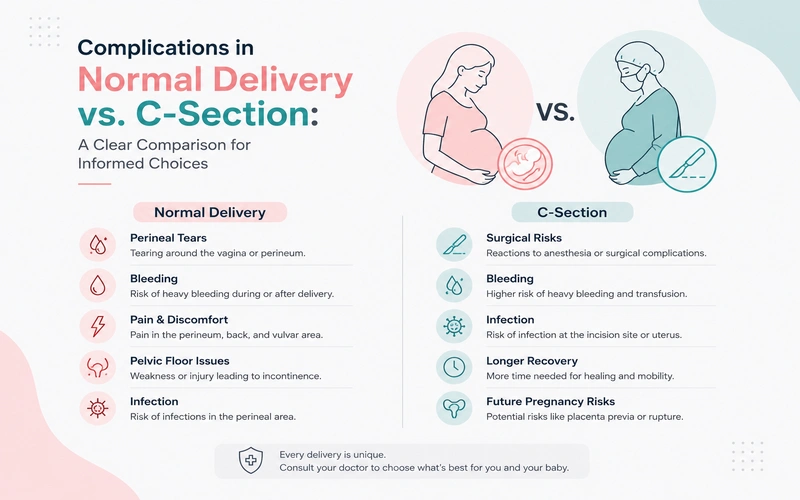
Common Complications in Normal Delivery
Vaginal delivery is generally the lower-risk option for most healthy, low-risk pregnancies, but it isn’t without potential complications:
- Perineal tears: Stretching or tearing of the vaginal tissue during delivery, which is extremely common; research shows up to 90% of women experience some degree of tearing during vaginal birth, most requiring stitches
- Prolonged or difficult labour: Labour duration is unpredictable and can lead to maternal exhaustion or fetal distress in some cases
- Postpartum hemorrhage: Excessive bleeding after delivery, which can occur with either delivery method but has specific risk factors in vaginal birth
- Shoulder dystocia: A rare complication where the baby’s shoulder gets stuck during delivery, requiring prompt medical intervention
- Pelvic floor strain: Vaginal birth can weaken pelvic floor muscles, occasionally contributing to issues like urinary incontinence
Despite these possible complications, most normal deliveries proceed without serious issues, and recovery is typically significantly faster than after a C-section.
Common Complications in C-Section Delivery
A C-section is major abdominal surgery, and like any surgery, it carries its own set of risks:
- Infection: Of the incision site, uterus, or urinary tract, requiring antibiotics and monitoring
- Increased blood loss: C-sections generally involve more blood loss than vaginal deliveries
- Anaesthesia-related complications: Reactions to spinal, epidural, or general anaesthesia
- Blood clots: Major surgery increases the risk of venous thromboembolism
- Longer, more difficult recovery: Recovery typically takes six to eight weeks, compared to two to four weeks for vaginal delivery
- Risks in future pregnancies: Including placenta previa, placenta accreta, and, in rare cases, uterine rupture during a subsequent labour
- Respiratory issues in the newborn: Particularly when a C-section is performed electively before 39 weeks of pregnancy, since labour helps clear fluid from a baby’s lungs naturally.
So, Which One Is Actually Safer?
For a low-risk, uncomplicated pregnancy, medical evidence consistently points toward vaginal delivery as the safer option overall. According to the American Medical Association, the risk of severe maternal complications is three times higher after a C-section compared to a vaginal birth, including significantly elevated risks of infection, bleeding, and blood clots. This is precisely why doctors generally recommend vaginal delivery as the first choice whenever it’s medically appropriate, reserving C-sections for situations where they genuinely offer a safety advantage.
That said, “safer” isn’t a fixed answer, it depends entirely on individual circumstances. A C-section becomes the safer, and often necessary, choice in situations such as:
- Baby in a breech or transverse position
- Placenta previa or other placental complications
- Signs of fetal distress during labour
- Multiple pregnancies (twins or more) in certain positions
- A prior C-section with specific uterine scarring
- Prolonged labour that isn’t progressing safely
- Certain maternal health conditions where labour poses added risk
In these situations, a planned or emergency C-section significantly reduces risk to both mother and baby compared to continuing with vaginal delivery, effectively flipping the safety equation for that specific pregnancy.
Can You Have a Normal Delivery After a Previous C-Section?
In many cases, yes. This is known as VBAC (Vaginal Birth After Cesarean), and according to ACOG guidelines, it’s considered a safe option for many women, particularly when the previous C-section involved a low transverse incision and there are no ongoing high-risk conditions. Your obstetrician in Delhi can assess whether a trial of labour after a cesarean (TOLAC) is appropriate for your specific case.
Making an Informed Decision With Your Obstetrician
The right delivery method isn’t a one-size-fits-all decision, it depends on your health history, how your pregnancy is progressing, and how labour unfolds on the day itself. Open, ongoing conversations with your gynaecologist throughout pregnancy, not just in the final weeks, allow for a genuinely informed birth plan built around your specific situation, while still staying flexible if circumstances change during labour.
Conclusion
There’s no universal answer to whether normal delivery or C-section is “safer,” it genuinely depends on your individual pregnancy and health profile. For most low-risk pregnancies, vaginal delivery carries fewer complications and a faster recovery, while a C-section becomes the safer choice when specific medical circumstances call for it. If you’re planning your delivery in Rohini, Manasvi Healthcare can help you understand your options and build a birth plan suited to your specific needs.
Dr. Rachna at Manasvi Healthcare brings more than 18 years of experience in obstetrics and gynaecology. Manasvi Healthcare is a government-approved nursing home and MTP centre in Rohini, offering personalised prenatal care, careful delivery planning, and experienced support for both normal delivery and C-section, guided by each patient’s specific medical needs rather than a fixed protocol. Patients consistently describe Dr. Rachna’s approach as attentive and reassuring, exactly what matters most during one of life’s biggest moments.